
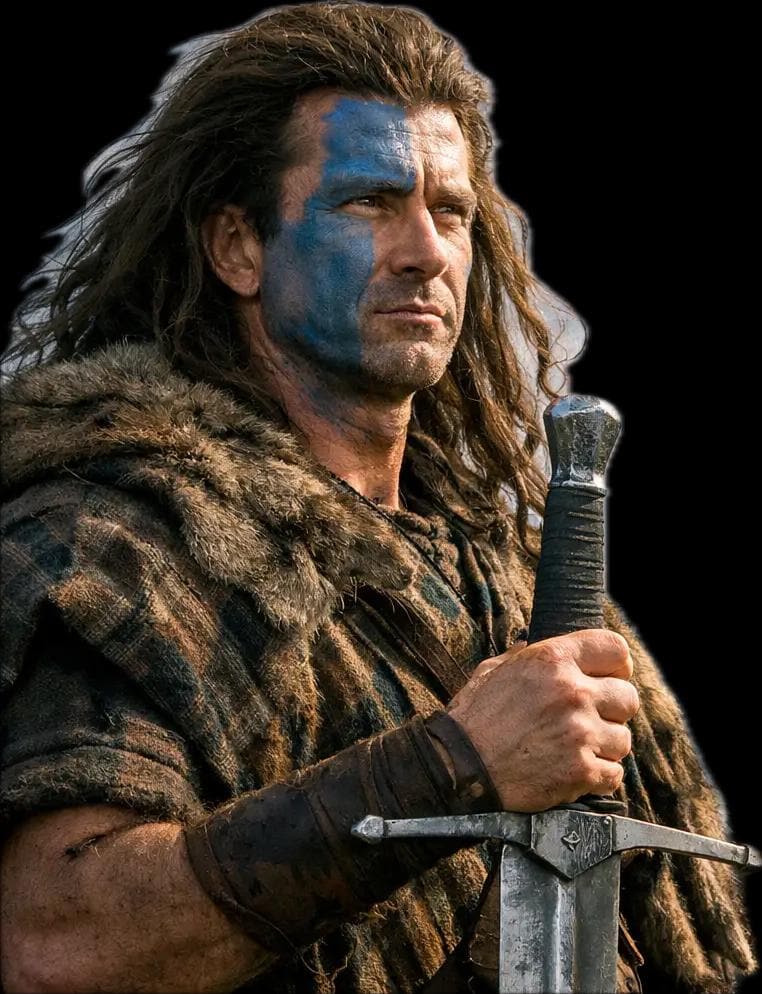
Ask the question plainly - did William Wallace win freedom for Scotland? If by freedom we mean a final, secure and lasting Scottish independence achieved in his own lifetime, the answer is no. Wallace became one of Scotland’s defining national heroes, but he did not live to see Scotland fully free of English control. Even so, stopping there misses why his name still carries such force.Wallace matters because he helped turn resistance into a national cause at a moment when Scotland was dangerously close to being absorbed by Edward I of England. He won battles, inspired support and proved that English power could be challenged. That did not settle the war. But it changed the shape of it.
Did William Wallace win freedom for Scotland? The short answer
No, William Wallace did not personally win Scotland’s freedom. He was executed in 1305, and Scotland’s independence was not secured until years later, most famously through the victories and diplomacy associated with Robert the Bruce and the Treaty of Edinburgh-Northampton in 1328.Still, a simple no can be misleading. Wallace was one of the key figures who kept the Scottish cause alive after political collapse and military defeat. Without men like Wallace, there may not have been a later path for Bruce to follow.So the better answer is this: Wallace did not finish the job, but he helped make the job possible.
Scotland before Wallace rose
To understand his role, it helps to look at the crisis Scotland faced in the 1290s. After the death of Alexander III and then the death of his heir, Margaret, Maid of Norway, Scotland entered a succession crisis. Several nobles claimed the throne, and Edward I was invited to arbitrate.Edward used that opening to press his own authority over Scotland. John Balliol became king in 1292, but he was repeatedly humiliated by Edward and treated more like a subordinate than an independent ruler. When conflict followed, Edward invaded, defeated Scottish forces and removed Balliol from power.By the mid-1290s, Scotland was not a free and stable kingdom confidently directing its own affairs. It was under intense English domination. That is the world in which Wallace emerged.
Why Wallace became important so quickly
Wallace was not the obvious candidate to lead a national struggle. He was not a crowned king, and he did not begin with the standing of the great magnates. That is part of what makes his rise so striking.In 1297, Wallace became one of the leaders of armed resistance against English rule. The precise details of his early actions are difficult to separate from later legend, but his military and political importance becomes unmistakable that year. Alongside Andrew Moray, he helped lead the Scottish victory at the Battle of Stirling Bridge.That battle mattered enormously. It was not a symbolic skirmish. It was a major defeat for English forces and showed that Scotland’s resistance was not yet broken. Stirling Bridge gave the rebellion credibility and gave Wallace national stature.At that point, freedom was still far away. But the idea that English occupation could be reversed no longer seemed impossible.
The victory at Stirling Bridge and what it changed
If people ask whether Wallace won freedom for Scotland, part of the confusion comes from the scale of his fame compared with the actual timeline of events. Stirling Bridge was a real and major Scottish success, and it helped make Wallace legendary.The battle also had practical results. It weakened English control in Scotland and allowed Scottish forces to push back. Wallace was later named Guardian of Scotland, governing in the name of King John Balliol. That title shows how far he had risen.Yet one great victory does not end a war of independence. Scotland still faced the resources of Edward I, one of the most formidable rulers in Europe. Wallace had proved resistance could win. He had not secured permanent freedom.
Why Wallace did not complete the fight
The central reason is straightforward: English power returned hard and fast. In 1298, Edward I personally led a campaign into Scotland and defeated Wallace at the Battle of Falkirk.Falkirk did not erase Wallace’s earlier achievements, but it did show the limits of Scottish resistance at that stage. Edward’s army was larger, better supplied and backed by a more powerful kingdom. Scotland’s nobles were also not always united, and that mattered. Independence movements rarely fail only because of one lost battle. They also struggle when leadership is divided and long-term support is uncertain.After Falkirk, Wallace resigned as Guardian. He continued in the cause, including diplomatic efforts abroad, but he never regained the same central command. In 1305 he was captured, taken to London and executed with brutal theatricality as a traitor.That execution is one reason Wallace looms so large in memory. He died not as a compromise figure, but as a martyr to the Scottish cause. Martyrdom, however, is not the same thing as victory.
Did William Wallace win freedom for Scotland, or did he inspire it?
This is where the more useful historical answer sits. Wallace did not deliver the final political settlement that secured Scottish independence. But he did something that can be just as important in a long war - he turned resistance into a continuing national struggle.He showed that Edward I could be fought. He gave the cause a heroic figure at a time when Scotland had lost a king and much of its political confidence. He also became part of a wider chain of resistance that made later victories possible.That does not mean every later success should be credited to Wallace. History becomes less useful when one person is made to carry the whole story. Robert the Bruce, James Douglas and many others played decisive roles in the years that followed. Bruce’s victory at Bannockburn in 1314 was especially important in securing Scotland’s position.But Bruce did not arise in an empty landscape. Wallace belonged to the earlier phase that kept Scottish opposition alive when submission might have become permanent.
Wallace versus Bruce: why the distinction matters
Popular memory often compresses events. Wallace and Bruce can seem like part of one single heroic tale, with one man passing the torch neatly to the next. Real history is rougher.Wallace was the insurgent leader and wartime symbol of resistance during a period of chaos. Bruce was the king who eventually transformed rebellion into state power. Those are different roles. Wallace was crucial, but he was not the man who secured the final recognised freedom of the Scottish kingdom.If you are looking for the cleanest answer, Bruce came closer to winning Scotland’s freedom. If you are asking who helped save the possibility of that freedom when it was in grave danger, Wallace belongs near the top of the list.
Why people still ask the question
Partly because Wallace is larger than life. Poems, chronicles, later nationalism and modern film all helped elevate him beyond the scale of many other medieval figures. He is remembered not just as a soldier, but as the embodiment of resistance.That can blur the difference between symbolic victory and political outcome. Wallace won glory, loyalty and an enduring place in Scottish memory. He won one of the most famous battles in Scottish history. He did not live to see the war concluded.There is also a deeper reason the question persists. People are often less interested in treaties than in turning points. Wallace feels like a turning point. He represents the moment Scotland refused to disappear quietly.
The fairest verdict on Wallace
So, did William Wallace win freedom for Scotland? Not in the final, formal sense. He did not secure independence by treaty, and he did not survive to see Scotland’s position restored.But dismissing him as a man who failed would also be wrong. Wallace was one of the leaders who kept Scotland in the fight at a moment when defeat looked very possible. He gave resistance momentum, military credibility and a powerful example of defiance. For many readers of Scottish history, that is exactly why he remains indispensable.If you want the clean historical answer, Wallace did not win Scotland’s freedom alone. If you want the fuller answer, he helped ensure that Scotland still had a freedom left to fight for.For anyone drawn to Scotland’s wars of independence, Wallace is best understood not as the final chapter, but as the figure who made the rest of the story impossible to ignore.