
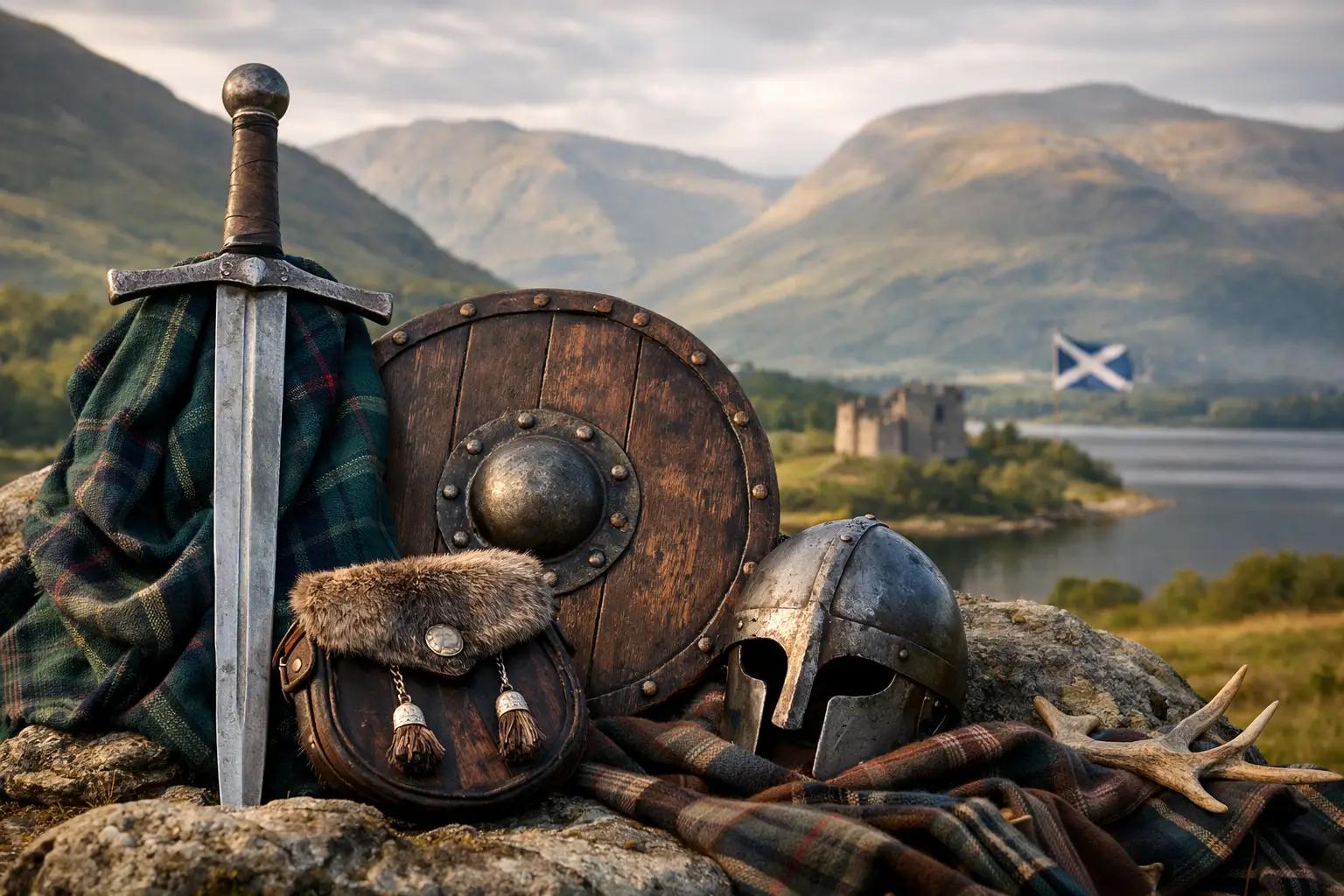
Ask what clan did William Wallace belong to, and the honest answer is less tidy than many modern family histories suggest. Wallace is one of Scotland’s most recognised national figures, but pinning him neatly to a later Highland-style clan identity does not fully fit the world he lived in. There is a strong historical case that he came from the Wallace family of Elderslie in Renfrewshire, while other traditions point to Ayrshire. What is clear is that he was a Wallace by family name. What is less clear is whether that should be treated as belonging to a clan in the way many people now mean it.
## What clan did William Wallace belong to in historical terms?
If you are looking for the simplest answer, William Wallace is usually associated with Clan Wallace. That is the name most readers will encounter in modern clan histories, genealogy references, and heritage material. It is also the answer that fits current Scottish clan structures, where Wallace is recognised as a clan surname.
The complication is that Wallace lived in the late thirteenth century, at a time when Scotland’s social and political organisation was not identical to the clan system that many visitors and ancestry enthusiasts picture today. In the Lowlands, where Wallace’s family connections are usually placed, kinship, lordship, landholding, and feudal ties often mattered more than the later romantic image of tartan-based clan identity.
So yes, it is reasonable to link him with Clan Wallace. But if the question is meant in a strictly medieval sense, historians tend to be more cautious. Wallace was certainly part of the Wallace family line. Whether he would have described himself as belonging to a clan in the later, formalised sense is another matter.
## Why the answer is debated
The debate exists for two main reasons. First, the surviving evidence for Wallace’s early life is limited. He became famous because of his role in resistance to English rule, not because chroniclers carefully recorded every detail of his childhood and family background. Much of what people think they know about him was shaped later by tradition, patriotic storytelling, and literary treatment.
Second, the modern idea of clans can flatten important regional differences. For many readers, a Scottish clan means a named group with a chief, badge, tartan, and long continuous identity. Some of that framework became far more visible and formalised centuries after Wallace’s lifetime. Medieval Scotland had powerful kin groups, of course, but the language and structure were not always used in the same way across the country.
That is why some historians answer cautiously. They do not necessarily reject the Wallace clan connection. They simply want to avoid turning a probable family association into a more polished certainty than the evidence supports.
### The Elderslie tradition
The best-known tradition places Wallace at Elderslie in Renfrewshire. According to this view, he was the son of Sir Malcolm Wallace of Elderslie. This became the familiar story in popular history and remains deeply rooted in Scottish heritage culture.
Elderslie suits the broad idea of Wallace as a Lowland knightly figure rather than a Highland clan warrior. It also aligns with the surname itself, which is often understood to derive from a term meaning Welshman or foreign Briton, suggesting an older ethnic or regional background rather than a purely Gaelic clan origin.
Still, tradition is not the same as proof. Elderslie is important in the Wallace story, but historians have questioned whether the evidence is as firm as popular memory makes it seem.
### The Ayrshire claim
Another line of argument connects Wallace to Ayrshire, particularly through a father identified as Alan Wallace. Some documentary evidence has led historians to treat this possibility seriously. If correct, it would place Wallace within a different branch of the Wallace family than the better-known Elderslie version.
For most general readers, this does not change the broad answer very much. In either case, Wallace belongs to the Wallace family network. The real issue is not whether he was a Wallace, but which Wallace line he came from and how securely we can know it.
## Clan Wallace and the Wallace surname
Modern Clan Wallace is recognised within Scottish clan tradition, and many people with the surname Wallace understandably look to William Wallace as the clan’s defining historical figure. From a heritage point of view, that connection is powerful and widely accepted.
The surname itself has deep roots. It appears in forms such as le Waleis, meaning someone associated with the Welsh or Brittonic peoples. Over time, it became a hereditary surname in Scotland. That matters because it reminds us that surnames often developed long before the modern clan industry, with its set visual markers and later ceremonial structures.
For diaspora readers, this is where the question often becomes practical. If your surname is Wallace and you are tracing ancestry or Scottish identity, William Wallace is naturally the most famous historic figure attached to the name. That is a legitimate heritage connection. It just helps to keep the terminology precise: surname, family line, and clan are related ideas, but they are not always interchangeable in every period.
## Was William Wallace a Highlander?
This is one of the most common misunderstandings around Wallace. He is not best understood as a Highland clan chief in the later popular sense. His world was tied more closely to the Lowlands, Anglo-Norman feudal structures, local lordship, and the political struggle over Scotland’s crown and independence.
That does not make him any less Scottish or any less central to the national story. It simply places him more accurately in his own time. The Wallace most readers recognise from legend can easily be pulled into a broader, romantic image of medieval Scotland that blends regions and centuries together. Real history is more specific.
If you picture tartans, pipes, and formal clan pageantry, you are mostly picturing later developments or later cultural packaging. Wallace belongs to an earlier and more complex Scotland.
## What the sources actually support
The strongest historical footing is this: William Wallace was a member of the Wallace family, almost certainly from a minor noble or knightly background, and modern tradition associates him with Clan Wallace. Beyond that, certainty narrows.
Blind Harry’s famous fifteenth-century poem did a great deal to shape Wallace’s image, but it was written long after Wallace’s death and mixes memory, patriotism, and literary drama. It remains culturally important, yet it cannot be treated as straightforward biography. More contemporary records are sparse and often frustratingly incomplete.
That means any firm claim about Wallace’s exact clan status should be handled carefully. A clean answer works well on souvenir copy. History usually asks for a little more restraint.
## Why this question matters to ancestry and heritage readers
For many people, asking what clan did William Wallace belong to is really a way of asking where he fits in the larger map of Scottish identity. Was he part of a clan, a family line, a noble house, or something else? The answer matters because it shapes how modern readers connect with him - especially those exploring surname history, diaspora roots, or travel plans linked to Wallace landmarks.
There is also a broader point. Wallace stands at the crossroads of history and national memory. He is not just a man in records. He is a symbol, and symbols often get simplified. Understanding the uncertainty around his background does not weaken his story. It makes it more historically grounded.
For readers who enjoy Scottish history in focused, accessible form, this is exactly the sort of detail that rewards a closer look. The famous headline answer is Clan Wallace. The more useful answer is that he belonged to the Wallace family, likely from a Lowland noble line, and later clan tradition preserves that identity in a form modern audiences can recognise.
## So, what should you say?
If you want a short, practical answer, say that William Wallace is associated with Clan Wallace. That is the standard modern response and the one most people will expect.
If you want the historically careful version, say that William Wallace belonged to the Wallace family and is linked by modern tradition to Clan Wallace, but medieval evidence about his precise branch and status is not fully settled. That answer takes slightly longer, yet it is much closer to the truth.
For anyone browsing Scottish history by subject - whether for ancestry, travel inspiration, or simple curiosity - Wallace is a good reminder that the best-known names are not always the easiest to pin down. Sometimes the most interesting part of the story is the gap between legend and record, and Wallace remains one of Scotland’s clearest examples of that.